Stay in the Know About Salem
Get upcoming events, things to do & seasonal news straight to your inbox.
Sign Up Now



Photo Credit: @creativecollectivema

Photo Credit: @creativecollectivema
Photo Credit: @creativecollectivema
Photo Credit: Jess Shada

Photo Credit: Jess Shada

Photo Credit: Jess Shada

Photo Credit: Kathy Tarantola


Step Inside Salem’s Global Story: East India Marine Hall Reopens at PEM
March 20, 2026
Written By:
Bridie O'Connell
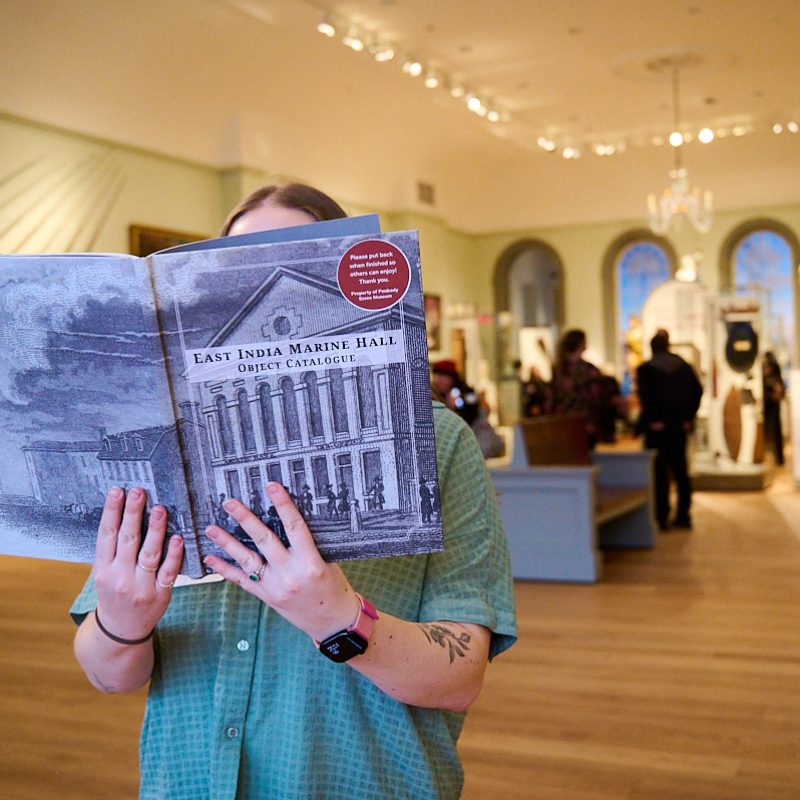
SPONSORED CONTENT | Written / Photographed by Destination Salem
East India Marine Hall has always been at the center of Salem’s story. Now, it’s open again in a whole new way.

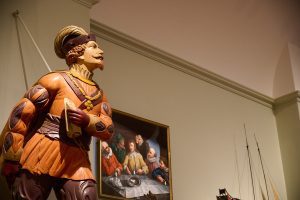
After a major reinstallation, this historic space at the Peabody Essex Museum feels both familiar and completely different. Built in 1825 as the museum’s first exhibition space, the hall has long reflected Salem’s connection to the wider world. This revamped installation brings that story forward for exploration on your own terms.
There’s no set path through the space, which is part of what makes it work so well. You’re not being guided from one stop to the next — you’re encouraged to follow your own curiosity. You might walk in and head straight for a ship model, a carved figurehead, or a golden bird and her nest in a giant glass display case. You might take a slow lap around the room and let the details build over time.
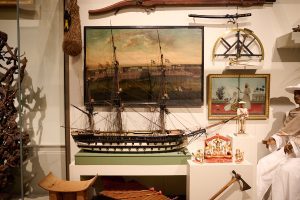

That flexibility makes it an easy addition to any visit. You can spend ten minutes here and still get something out of it, or stay longer and keep discovering new layers. It’s also the kind of place that rewards repeat visits. What catches your attention one day might be completely different the next, especially as you begin to notice connections between objects you may have missed before.
The biggest shift, though, is how the stories are told.
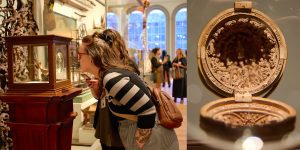
The objects themselves come from around the world, collected by Salem’s sea captains during the late 18th and 19th centuries. You’ll see everything from maritime artifacts to cultural objects and natural specimens, items that once arrived in Salem after long voyages across the globe. Many of these objects were originally displayed together in ways that reflected curiosity more than structure, and this new installation intentionally brings some of that feeling back. You might even come across an item previously displayed in a different part of the museum!

But it doesn’t stop there. Instead of presenting these pieces as static artifacts, the exhibition opens up multiple perspectives, pulling in voices from the past alongside contemporary interpretations. You’ll hear from early collectors, but also from people connected to the cultures these objects came from, as well as scholars and artists today. That mix adds context, but it also raises new questions. It turns what could feel like a static display into something more active and evolving, where each object carries more than one story.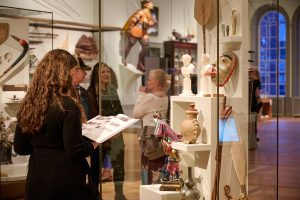
There’s also a strong digital layer built into the experience. Throughout the Hall, QR codes connect to additional content on your phone, including audio, deeper object histories, and stories that go beyond what’s visible in the gallery. In some cases, you can hear instruments or listen to people speak directly about the objects in front of you. You can engage with as much or as little of that as you want.
That balance between historic space and modern storytelling is what makes this reopening stand out. It’s not a fresh coat of paint on top of what once was. Instead, it keeps the spirit of the original experience — exploration, curiosity, discovery — and updates how you access it in a way that feels current.
As part of Salem 400+, it also feels like the right moment to step back into a space that has always been about Salem’s place in a global story.
If you’re visiting Salem for the first time, this is a strong place to start. And if you’ve been before, it’s worth coming back. The space may be historic, but the experience feels entirely new.

Privacy Policy | © 2026, All Rights Reserved. Website designed and developed by Sperling..